Binance in Taiwan
I did not write this plan. As a TA, I made sure it held up through three judged reviews.
- Problem
- A five-person student team had to grow Binance's users and trading volume in Taiwan, and defend the plan at three judged reviews.
- The turn
- I reviewed each round as a judge would, asking for the reasoning behind every step. One customer became two, each with a priced plan.
- Result
- Ranked 1st of all teams at the final review.
Situation
My role
Focused on the numbers, asking for the formula behind every figure. We both reviewed the logic.
Reviewed the logic with my co-TA, and led the coaching on how the analysis was presented.
I was one of two Teaching Supervisors on the team, alongside a mentor. TAs did not do the research; our job was to review the work and keep its direction sound. At each round I read the deck the way a judge would, and where an argument jumped a step, I sent it back.
A simulated consulting case, reviewed three times. The NTHU Consulting Group, a student consulting club, assigned each team a different real company to grow. Ours was Binance in Taiwan, from September to December 2025. It was a training exercise with no affiliation to Binance. Internal company data was not available, so company-level figures are the team’s estimates.
- Review 1One customer for everythingTargets 18-to-29-year-olds for both goals, on desk research alone.
- Review 2Two goals, two customersSplits the market after a 191-response survey.
- Review 3A priced plan for each customerSizes every target, values each user and costs each lever.
The turn
One question, every round: why?
- Who
- Know about crypto, but hesitate
- Segmented by
- Position in the marketing funnel
- Who
- Willing to commit NT$10K–1M
- Segmented by
- Age × amount willing to invest
The work
Accurate is not the same as clear. The research and the strategy were the team’s. My part was making sure they held together, and that they landed in a twenty-minute review.
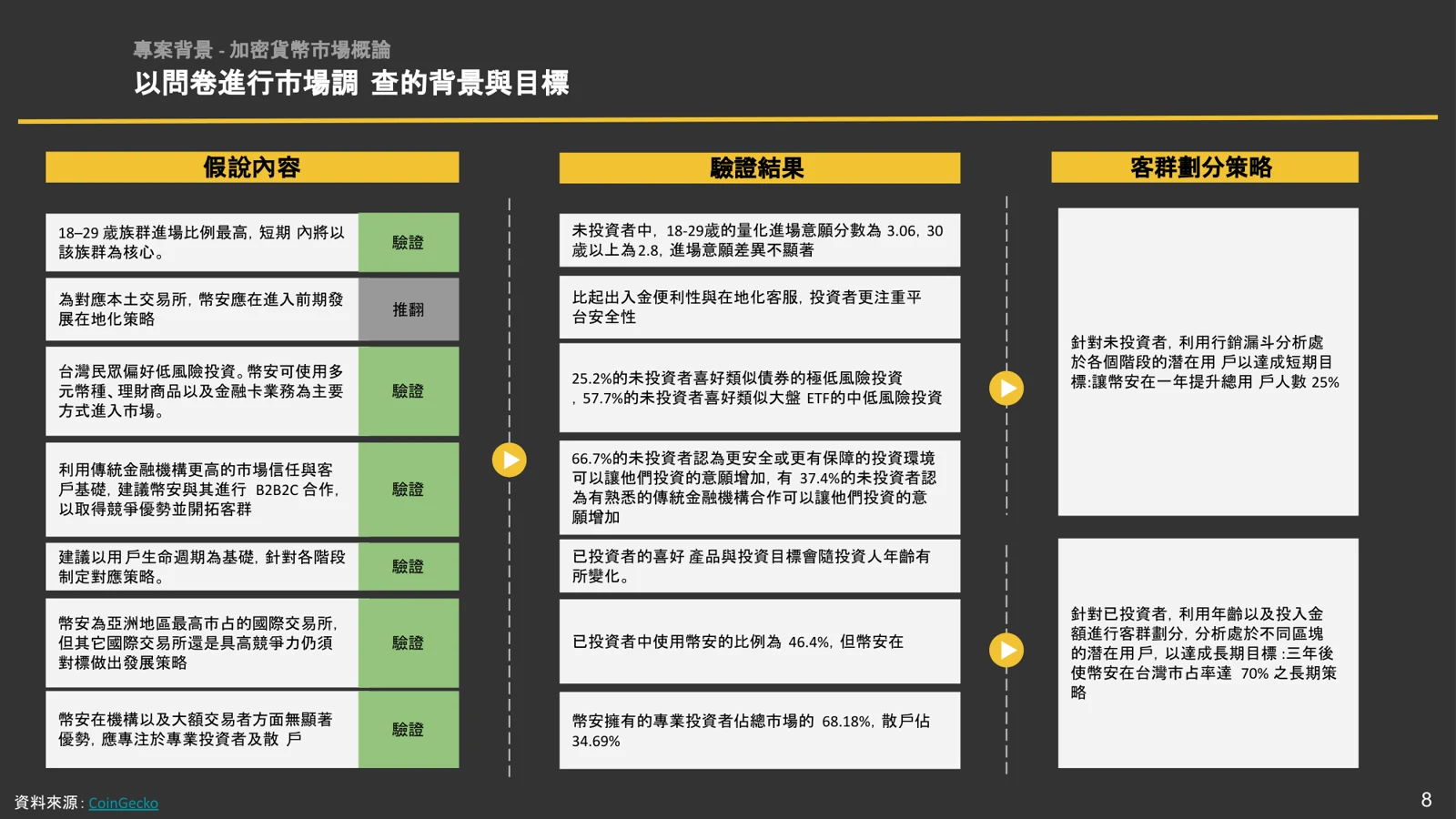
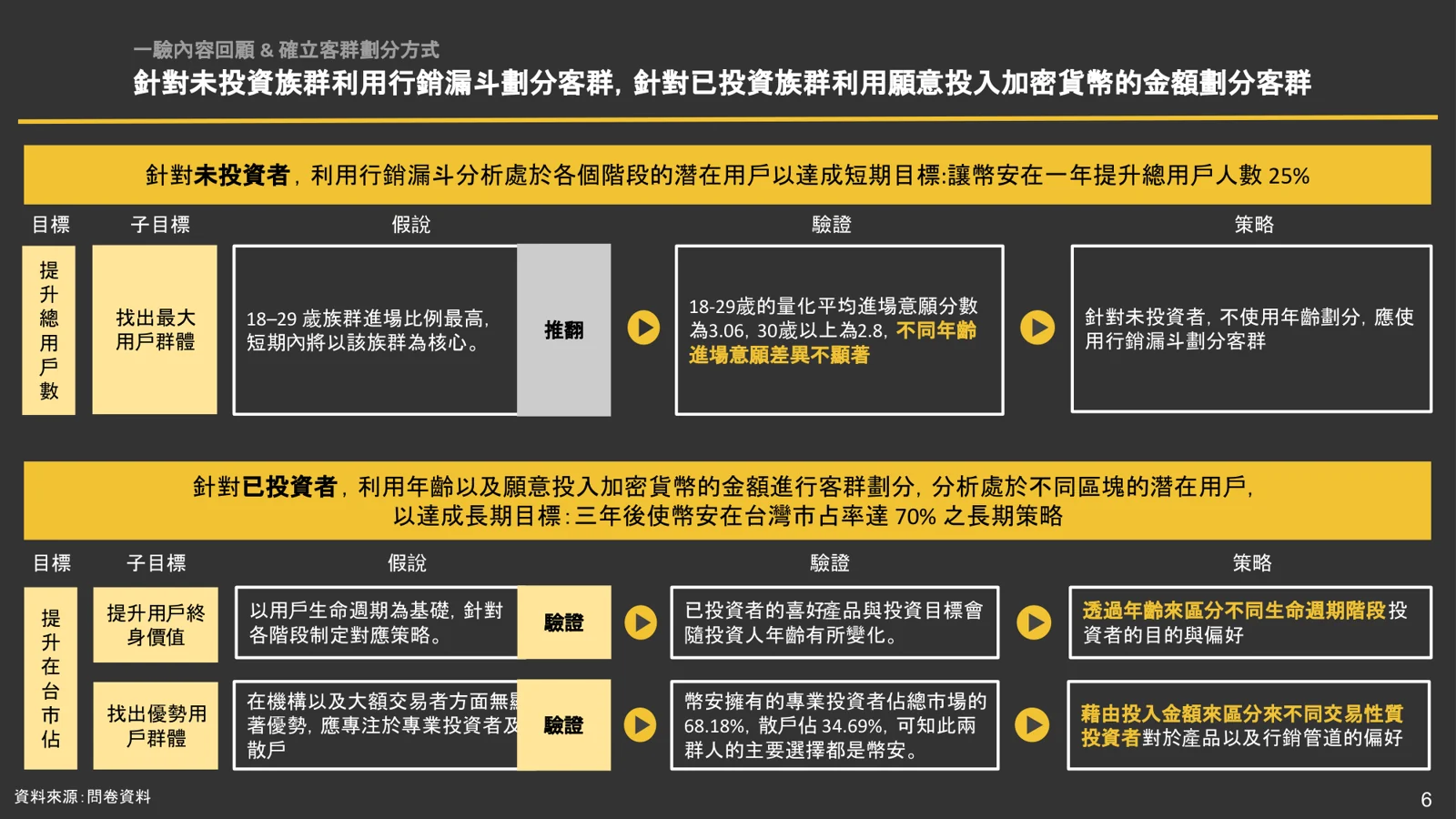 123
- Hypothesis, evidence and strategy now read across one line
- The key finding is highlighted
- Colours reduced to the team's main palette
The rules I coached: lead every slide with its insight, agree the colour rules before anyone builds a chart, highlight the one figure that matters and grey out the rest, and cut the text until the argument reads top to bottom.
Outcome
Ranked 1st of all teams at the final review.
Two perspectives, one question: why?
The team's domain knowledge exceeded what any judge would bring, and that proximity made it easy to lose sight of the top-down narrative. Reviewing as a third party allowed me to identify where the argument lost coherence.
Before flagging an issue, I first sought to understand the mentee's reasoning. Only then could I pinpoint the gap I saw and articulate my own rationale rather than simply issuing a judgement.
Alternating between these two perspectives instilled the habit of challenging my own reasoning with the same question I put to the team: why?
A simulated consulting exercise run by a student club; each team was assigned a different company. Not affiliated with Binance. Figures are the team’s research and estimates at the time, including a 191-response survey.
Next projectBridging Bands and Musicians